
Investment Adviser Representative Continuing Education General FAQs
Investment adviser representatives (IARs) need to follow continuing education (IAR CE) requirements set by the state securities regulators where they’re registered. These requirements match the NASAA Model Rule on Investment Adviser Representative Continuing Education. The rule applies to IARs from both state-registered and SEC-registered investment adviser firms in states that have adopted it.
Yes. In addition to IARs who are currently registered in a jurisdiction that has adopted NASAA’s IAR CE Model Rule, an IAR will have an IAR CE requirement if they were previously registered as an IAR in such a jurisdiction for all or part of a year, or if they enrolled in NASAA’s IAR Exam Validity Extension Program (“IAR EVEP”) to extend the validity of their IAR qualification exam after their registration was terminated.
When an investment adviser representative (IAR) registers with an IAR CE jurisdiction for the first time, they need to complete the annual IAR CE requirements by the end of the first full calendar year after their initial registration. Keep in mind, this grace period only applies to IARs who are registering for the first time. Those who already have active registrations and simply add a new state registration must meet the IAR CE requirements for the current year in all states where they are registered.
• Arkansas (effective 2023)
• California (effective 2024)
• Colorado (effective 2024)
• Florida (effective 2024)
• Hawaii (effective 2024)
• Illinois (effective 2026)
• Indiana (effective 1/1/2027)
• Kentucky (effective 2023)
• Maryland (effective 2022)
• Michigan (effective 2023)
• Minnesota (effective 2025)
• Mississippi (effective 2022)
• Nebraska (effective 2025)
• Nevada (effective 2024)
• New Jersey (effective 2025)
• North Dakota (effective 2024)
• Oklahoma (effective 2023)
• Oregon (effective 2023)
• Rhode Island (effective 2025)
• South Carolina (effective 2023)
• Tennessee (effective 2024)
• Vermont (effective 2022)
• Washington (effective 1/1/2027)
• Washington, D.C. (effective 2023)
• Wisconsin (effective 2023)
• U.S. Virgin Islands (effective 2025)
NASAA’s Model Rule on IAR CE requires that IARs complete a total of twelve IAR CE courses by December 31 of each year. Of these twelve courses, six must be in the Products & Practice category, and six must be in the Ethics & Professional Responsibility category. A seventh course taken in either category will not count towards an IAR’s requirement.
No. Twelve IAR CE credits will satisfy the IAR CE requirements of all states in which an IAR is registered.
No. IARs will need to take new courses each year. IAR CE courses will only count once towards an IAR’s regulatory requirement.
No. However, NASAA permits continuing education providers to offer courses that satisfy multiple CE requirements, including those for IARs and certain professional designations.
To the extent that FINRA continuing education (“FINRA CE”) is found satisfactory by NASAA, dually registered investment adviser representatives/registered representatives (“IARs/RR”) can count FINRA CE toward the IAR CE Products and Practice credits. A dually registered IAR/RR would still need to complete at least six credits of Ethics and Professional Responsibility IAR CE approved by NASAA.
If an investment adviser representative (“IAR”) does not fulfill the annual continuing education requirement by the end of the calendar year, the IAR’s registration status on WebCRD will be set to “CE Inactive,” which will be viewable by state securities regulators and by the general public on IAPD and Broker Check. The CE Inactive status will remain until the deficiencies are corrected or action is taken by the applicable state securities regulator(s). If the CE Inactive status persists through the close of the following calendar year, the IAR will be ineligible to renew their registration or to initiate a new IAR registration via WebCRD until the deficiency is corrected.
No, credits earned in excess of the annual continuing education (“CE”) requirement will be recorded on the transcript of an investment adviser representative (“IAR”) but cannot be used to satisfy the CE requirement in subsequent years. In the event an IAR has a CE deficiency from a prior year, any credits earned will be first applied to the prior year deficiency before being used to satisfy a current year’s CE requirement.
No. Only the representative that is licensed in a state that has adopted an IAR CE rule must comply with the requirement. However, the investment adviser firm should ensure it has adopted IAR CE compliance policies and procedures (i) to support its representative’s compliance with the requirement, and (ii) to monitor IAR CE requirements for all representatives as new states continue to adopt the model IAR CE rule.
Yes, the investment adviser representative (“IAR”) must correct any continuing education (“CE”) deficiency prior to re-registering as an IAR or, alternatively, the IAR can retake the Series 65 or Series 66 exam (or satisfy an applicable state securities regulator’s exam waiver).
IAR CE Status & Tracking FAQs
IARs can review their IAR CE status, completed courses, and CE history by logging in to FINRA’s Financial Professional Gateway (“FinPro Gateway”). If the IAR has an IAR CE requirement, their status is displayed in the Continuing Education Program Status section of the dashboard, as well as at the top of the My Continuing Education page. If the IAR’s status is Required, CE Inactive, Fail to Renew, or Termed, an IAR CE reminder will also appear in the My Tasks list on the dashboard. If the IAR’s firm has set an internal due date for IAR CE that is earlier than the program due date, the firm’s due date will be displayed alongside the status, and both dates can be viewed in the IAR CE section of the Continuing Education Details. IARs who do not yet have a FinPro Gateway account can find setup instructions on FINRA’s website. For a step-by-step walkthrough, see FINRA’s guide at https://www.finra.org/sites/default/files/2025-08/Tracking_IAR_CE_in_FinPro.pdf.
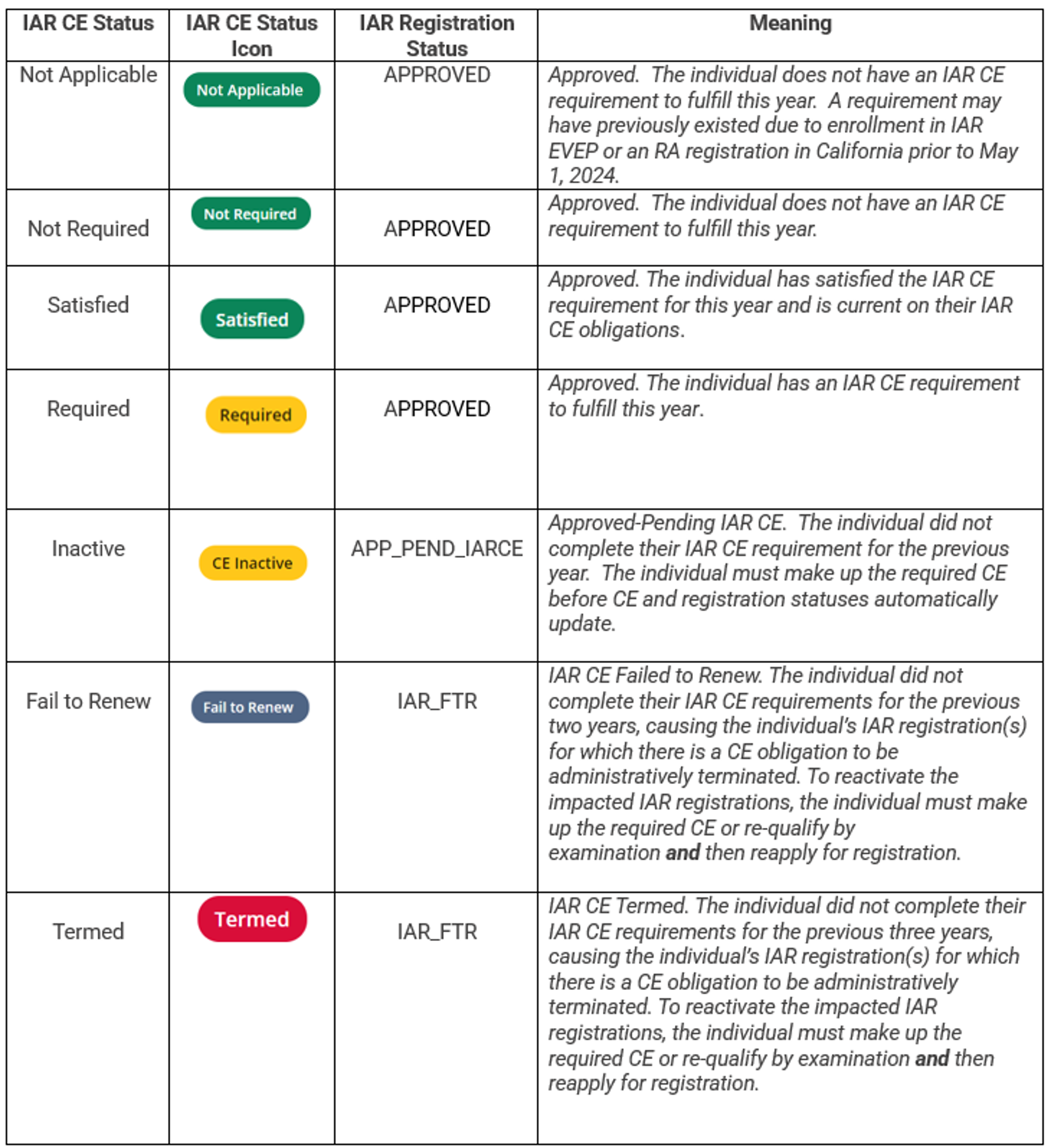
An investment adviser representative’s (“IAR’s”) continuing education (“CE”) status indicates whether the IAR has an IAR CE requirement for the current year and, if so, whether they have satisfied it. There are seven possible statuses: Not Applicable, Not Required, Satisfied, Required, CE Inactive, Fail to Renew, and Termed. The first four are associated with an approved IAR registration. CE Inactive indicates that the IAR did not complete the prior year’s requirement and that their registration is pending completion of IAR CE. Fail to Renew and Termed indicate that the IAR’s registration(s) in jurisdictions with an IAR CE requirement have been administratively terminated because of unresolved deficiencies. A full description of each status, along with its corresponding registration status, is available here: https://ce4advisers.com/wp-content/uploads/2026/11/Picture1.png (courtesy of NASAA).
Once an investment adviser representative (“IAR”) has been registered for any part of a calendar year in a state that has adopted the IAR continuing education (“CE”) requirement, the IAR becomes subject to that requirement, and it does not end when the IAR withdraws from that state. The requirement carries forward into subsequent years, and if the IAR does not complete the annual requirement, the resulting deficiency will continue to accumulate, up to a maximum of 36 credits. An IAR CE deficiency will not affect an IAR’s registration in states that have not adopted the IAR CE rule. However, if one of those states adopts the rule in the future, the IAR’s registration in that state will be affected as of the rule’s effective date if the deficiency has not been corrected. A deficiency will also affect any future registration in a state that already requires IAR CE. For this reason, IARs who have withdrawn from an IAR CE state should continue to complete their annual IAR CE requirements to avoid complications with future registrations.
Both statuses indicate that the IAR’s registration is approved and that the IAR does not have an IAR CE requirement to fulfill in the current year. “Not Applicable” additionally indicates that the IAR may have previously had a requirement, either because they enrolled in the IAR EVEP or because they were registered as a representative of an investment adviser (“RA”) in California prior to May 1, 2024.
There are several possible reasons. First, course completions are posted to an IAR’s transcript only after the course provider reports them to FINRA, so there may be a delay between completing a course and seeing it in FinPro Gateway. CE4Advisers.com generally submits course completion results once per week. Second, credits are always applied to the earliest year with a deficiency, so if the IAR has an outstanding deficiency from a prior year, new credits will be applied to that year before they count toward the current year. Third, a course may have been posted with zero credits (see below). Finally, both the provider and the specific course must be approved by NASAA for IAR CE credit.
A course will be applied with zero credits for one of two reasons: either the IAR has already received credit for that course, or the IAR has already satisfied the requirement for that course’s credit category for the year. Courses are identified by a course ID, and an IAR can only receive credit for a course the first time it is reported. Likewise, because the annual requirement is six credits of Products & Practice and six credits of Ethics & Professional Responsibility, any credits taken in excess of six in a single category for a given year will receive zero credit and cannot be carried forward. In FinPro Gateway, an information icon next to a zero-credit course will explain which reason applies.
A CE Inactive status means the IAR did not complete their IAR CE requirement for the previous year. The IAR’s registration status will show as approved-pending IAR CE (“APP_PEND_IARCE”) until the deficiency is corrected. To resolve it, the IAR must make up the missing credits; once the deficiency has been satisfied, both the CE status and registration status will update automatically. Credits earned while an IAR has a deficiency will first be applied to the prior-year deficiency before counting toward the current year’s requirement.
Both statuses mean that the IAR’s registration(s) in jurisdictions with an IAR CE requirement have been administratively terminated. Fail to Renew indicates that the IAR did not complete their IAR CE requirements for the previous two years, while Termed indicates that the requirements were not completed for the previous three years. In either case, the registration status will show as IAR CE Failed to Renew (“IAR_FTR”), and the IAR must make up the required CE or re-qualify by examination, and then reapply for registration, to reactivate the affected registrations. Reapplying alone is not sufficient.
IARs can print or save their IAR CE transcript from FinPro Gateway by selecting the Print CE Transcript button at the top right of the My Continuing Education page. A pop-up will allow the IAR to choose which programs to include (for example, IAR CE only), and a PDF will then open that can be printed or saved. Courses for the current year and any incomplete prior year appear on the Current CE tab, while each completed IAR CE year appears on the CE History tab once all twelve credits have been reported.
CE4Advisers.com FAQs
Our IAR CE courses consist of one-hour video presentations that must be watched in their entirety. During the video, the instructor will provide two halves of a six-character attendance code, which must be recorded by the attendee. After the video, the attendee will need to provide the six-character code to advance to the next section of the course. This next section consists of a course evaluation and a final assessment. Once the assessment has been passed, the attendee will be asked to certify their attendance by providing their full name, the date, and their individual CRD number. Once all of these steps have been completed, a certificate of attendance will be generated for the attendee’s records.
The final assessment for each course consists of 10 randomized questions. A passing score is 70%, and an attendee will have a total of three attempts to receive a 70% score. If an attendee fails the assessment three times, they will need to repeat the entire course from the beginning.
According to NASAA’s Model Rule, it is the responsibility of course providers to report course completion results to the regulators. Generally, CE4Advisers.com submits course completion results once per week.
Courses are accessed from the “My Courses” section of the “My Account” page. You will also receive a direct link to a purchased course in the receipt emailed to you after making a purchase.
RIA Compliance Consultants’ Annual Compliance Program packages provide some IAR CE credits at no additional charge. The list below shows how many credits are available through each package:
• Value, Bronze, Silver, Gold, Platinum: 6 credits
• Bronze+ : 12 credits
• Silver+ : 16 credits
• Gold+ : 20 credits
• Platinum+ : 24 credits
• Titanium: 28 credits
No, CE4Advisers.com requires separate login credentials from ria-compliance-consultants.com. An account will automatically be created for you during checkout.